Philadelphia Trends thru July 2012

Now that Summer is coming to an end, we can begin to take a look back to see just how the Philadelphia Single Family and Condo market fared.  Below is a chart comparing year over year activity in Philadelphia for July 2011 and July 2012.  Based strictly on the numbers, the overall Philadelphia market appears to be improving, albeit in very small increments.  On a neighborhood by neighborhood basis, the trends may differ.

Let me know if this is what you see in your markets.

Click on the chart for an enlarged view (you may have to click on it twice).


 * Data provided by TReND MLS


Share

Bucks & Chester County Tax Appeal Deadlines Approaching

The deadline for filing a tax assessment appeal in Bucks and Chester Counties is quickly approaching.  August 1, 2011 is the final day that assessment appeals can be filed with the Assessors Office for Bucks and Chester County. 

So, if you are thinking about filing an appeal, now is the time to act.  You will need to fill out a appeal application and submit it to the assessor’s office along with the appropriate filing fee.  In Bucks and Chester Counties the filing fee for a residential property is $25.

In an assessment appeal the burden of proof is on the property owner.  If you are going to represent yourself, you will need all the documentation necessary to support your case.  You should bring pictures of your property, including any damage or detracting features.  You should have information on comparable sales in your neighborhood.  You can get this from the public records, from a real estate agent of from websites like Zillow.  However, I would not recommend Zillow since the values the site produces can be grossly inaccurate. 

Having a current appraisal of your home completed by a certified real estate appraiser specifically for the purpose of the tax appeal is probably your best alternative.  An appraisal completed for any other purpose such as a refinance could be rejected by the Board at the hearing.  The cost of the appraisal can easily be offset by the savings from a successful appeal.  Some appraisers will even attend the hearing with you (sometimes for a fee) so that they can answer any questions the Board of Assessment may have about the appraisal while hearing your case.  Remember, appraisers cannot advocate for you.  You will have to be your own advocate.  The appraiser can; however, answer questions about the appraisal done on your property.

If you elect to have someone represent you at your hearing (either a professional tax appeal firm or an attorney), they will take care of the application process, obtaining an appraisal and representing you at the appeal hearing.  In some cases, this can really work in your favor.  These professionals know the system and can advocate on your behalf.   We work with a number of tax appeal firms and would gladly provide recommendations if you need one.

If you are not sure whether or not you have a case for an appeal, please feel free to contact one of the appraisers at our office.  We will take a look at your situation and give you an indication as to whether an appeal would be worth your while. 

But hurry…time is running out!

Share

No Housing Recovery until 2014 Reports Appraiser News

In an email released this morning, AppraiserNews.com reported that there is mounting evidence that there will not be a housing recovery until 2014.  They cite several recent articles and surveys that have been released by noted market analysts and research companies that follow the real estate markets.

Below is the article.  When reading it and the cited studies, keep in mind that the analysis is from a national perspective.  Remember, real estate is a local topic.  What is happening nationally may not be reflective of what is happening in the local Philadelphia region.

TUESDAY, MAY 24TH, 2011

The Reports are Unanimous, The Real Estate Market Continues to Worsen

Where do we begin? AppraiserNews.com has been warning about the storm clouds on the horizon for a prolonged period and has called for measures to deal with this crisis before it deepens.

While recent reports highlight the severity of the situation, those in a position to take actions to support the residential and commercial real estate markets are doing nothing positive to address the many problems. In no particular order, here are some of the recent studies and reports that we have viewed.

On May 18th, Prashant Gopal writing for Bloomberg cited a Trulia/RealtyTrac study which showed that more than of their survey respondents (homeowners and renters) now felt that they did not expect a recovery in the housing market for at least three years. The article quotes Pete Flint, Trulias CEO, as saying that We have another 18 months until we start to see signs of price stability in the housing market. The negative impact of the shadow inventory is prominently cited in the report by Mr. Gopal who refers to both CoreLogic and RealtyTrac findings. Forecasts by Moodys Analytics and S&P/Case-Shiller findings are also discussed in this report, a link to which is found here: US Housing Market May Not Recover Until 2014: Survey

In a report by CNBCs Diana Olick on May 16th, the lack of confidence of homebuilders as reflected in the National Association of Home Builders monthly report was discussed. Writing for Bloomberg the following day, Bob Willis discussed the unexpected decline in housing starts in the new Commerce Department report. Two days later, Mr. Willis along with Shobhana Chandra discussed the unexpected decline in existing home sales reported by the National Association of Realtors (NAR) that day along with the report that the Bloomberg Consumer Comfort Index also declined. Links to these three reports are found here:
Home Builder Sentiment Stagnates in May: NAHB

Housing Starts in U.S. Unexpectedly Fall to 523,000 Pace; Permits Decline

U.S. Economy: Previously Owned Home Sales Unexpectedly Fall

Share

Double Dip

It’s official, a report released by Clear Capital concluded that we are in a “Double Dip” real estate market.  This should come as no surprise to anyone who has been following this blog or tracking the foreclosure market.  Below is a video released by CNBC.com that explains what it is, how it got here and where we are going from this point.

One interesting statistic that they cite in the report is the fact that Philadelphia has fared relatively well in this down trend in the real estate market, only declining 2.2% below the market bottom of 2009. I guess that’s a small glimmer of hope that we can hold onto…for now that is.

Share

Shadow Inventory

On March 31, 2011 CoreLogic reported that the residential “shadow inventory” declined to 1.8 millions units, in January.  That’s great! Or is it? 

First, who is CoreLogic?  Well, they are a huge, publicly traded research firm that per their website “is a leader in innovative analytics, information and outsourcing solutions for businesses and government seeking dynamic insights.” 

What is a “shadow inventory”?  The “shadow inventory” is the built up stockpile of homes that are not listed in the Multiple Listing Service (MLS) that are either seriously delinquent, in foreclosure or REOs.  They are homes that may not be for sale yet but, may be on the market in the future.  Many of these homes are being held off the market by banks.  There are also more than 2.2 million homes that have negative equity and are likely to become part of the “shadow inventory”.  These properties are the “lurking-in-the-shadows-inventory”.

Now, while it is encouraging news that the “shadow inventory” went down in January, let’s put it in perspective.  In addition to the not yet on the market “shadow inventory” it is estimated that there are currently 3.5 millions homes in the nation’s official inventory.  Look at it this way, if no homes were put on the market, it would take more than 8.6 months to burn through the supply of official inventory.  

CoreLogic estimates that it will take 9 months to work through the 1.8 million homes that make up the “shadow inventory” at current absorption rates.  Factor in the 2.2 million homes that are part of the “lurking-in-the-shadows-inventory” and there is more than 2 years of housing inventory looming.  Personally, I feel the time required for the market to take back these inventories is more like 3-4 years.

While the numbers in the report paint a national picture, the local numbers are just as concerning.  In fact, New Jersey led the nation having the largest supply of distressed properties.  Pennsylvania was 18th overall, Delaware was 5th

What does this mean for our local real estate markets?  Well, just because a state may have a massive inventory of distressed homes does not necessarily mean continued plummeting prices.  But, the presence of these properties will act to slow the pace of the market’s recovery in those affected areas.  It’s simple supply and demand.  In this area, I would think that high-density markets like Philadelphia and Norristown will feel the pinch more than most.  But, realize that no market is going to be totally insulated from the wave of foreclosures looming off our shores.

Share

Inventory Levels

Inventory levels in the Philadelphia housing market are up over January 2010.  The latest data TReND MLS reports the following:

County Available Units Months of Inventory
Philadelphia 8,138 9
Montgomery 4,829 8
Bucks 3,421 8
Delaware 3,367 9
Chester 3,361 9

* Calculations based on single family dwellings as of 02/14/2011

These numbers basically tell us that if no more homes were listed for sale as of today, it would take 8 or 9 months to sell off the current inventory of homes.  This is an over-supply.  When there is an oversupply in the real estate market this puts downward pressure on pricing. 

Back when the market was on fire in 2004-2006, it was not uncommon to see inventory levels in the 2-3 month range.  In some areas, there were months that the levels went under 2 months.  Homes were selling the day that they went on the market.  This was a classic example of undersupply.  An “in balance” inventory is generally viewed as being between 3-6 months of supply.

It will be interesting to see how inventory levels are affected as the Spring Selling season begins.  Traditionally, Spring is the time when Sellers list their homes.  So we may see an uptick in inventory as new listings hit the market.  The question is, will the Spring Buyers be there to soak up the inventory?

Share

Mount Airy Trends

Being located in Erdenheim, just outside the city limits, we are frequently asked to appraise properties in northwestern Philadelphia, especially Chestnut Hill, Mount Airy, Roxborough and Manayunk. 

The other day we received our first question for the Ask PAB! section of the site.  It was submitted by a local agent who works primarily in the northwest section of Philly.  She typically deals with entry level and first time buyers.  For that segment of the market, Mount Airy offers a great selection of housing options for her clientele, in a wide range of price points and design styles.   It has very appealing housing stock, access to transportation, shopping, proximity to Center City and the suburbs and very unique community atmosphere.  Her question was simply:

 “How have Mt. Airy twins and rows been performing over the past couple of years?”

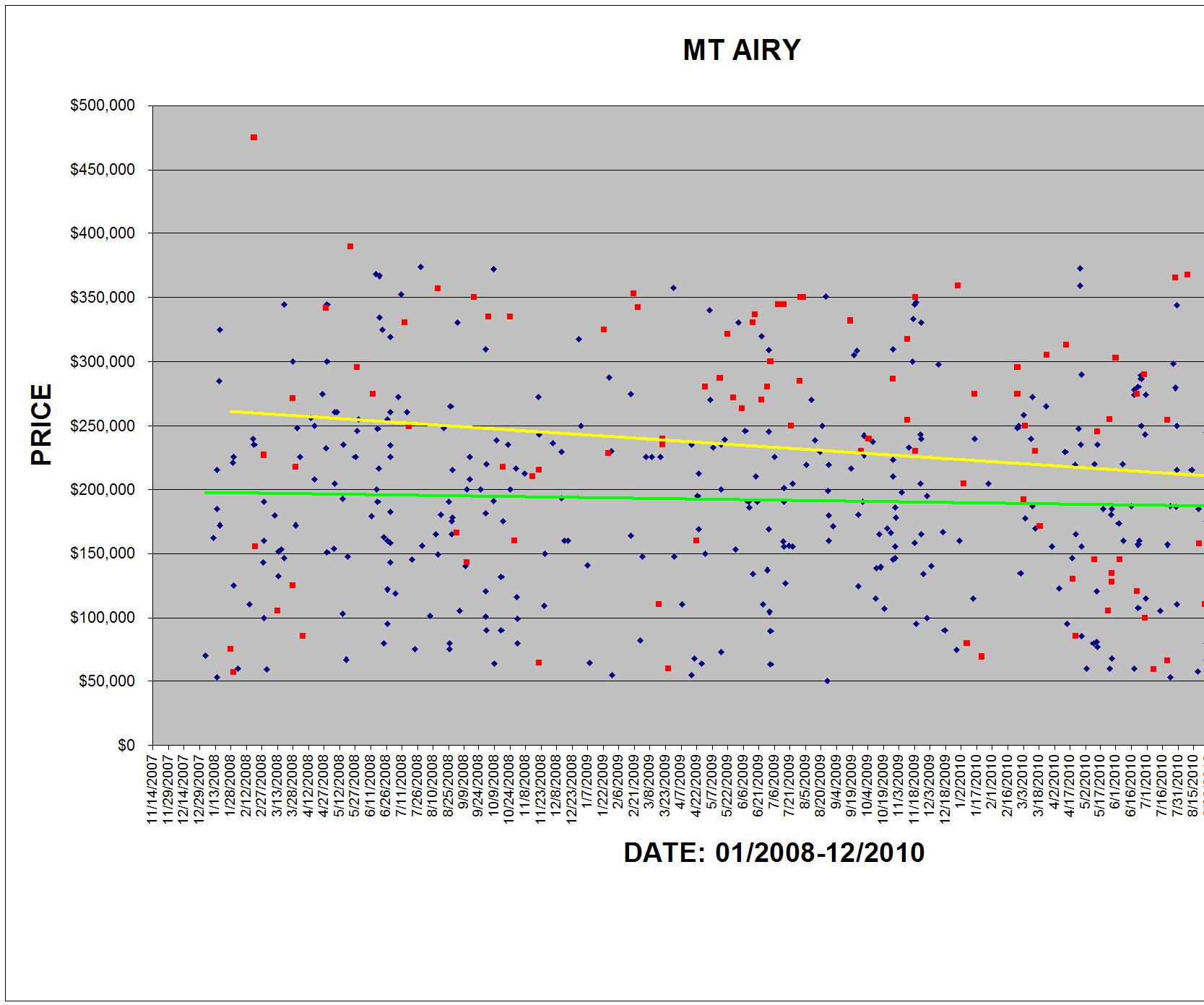
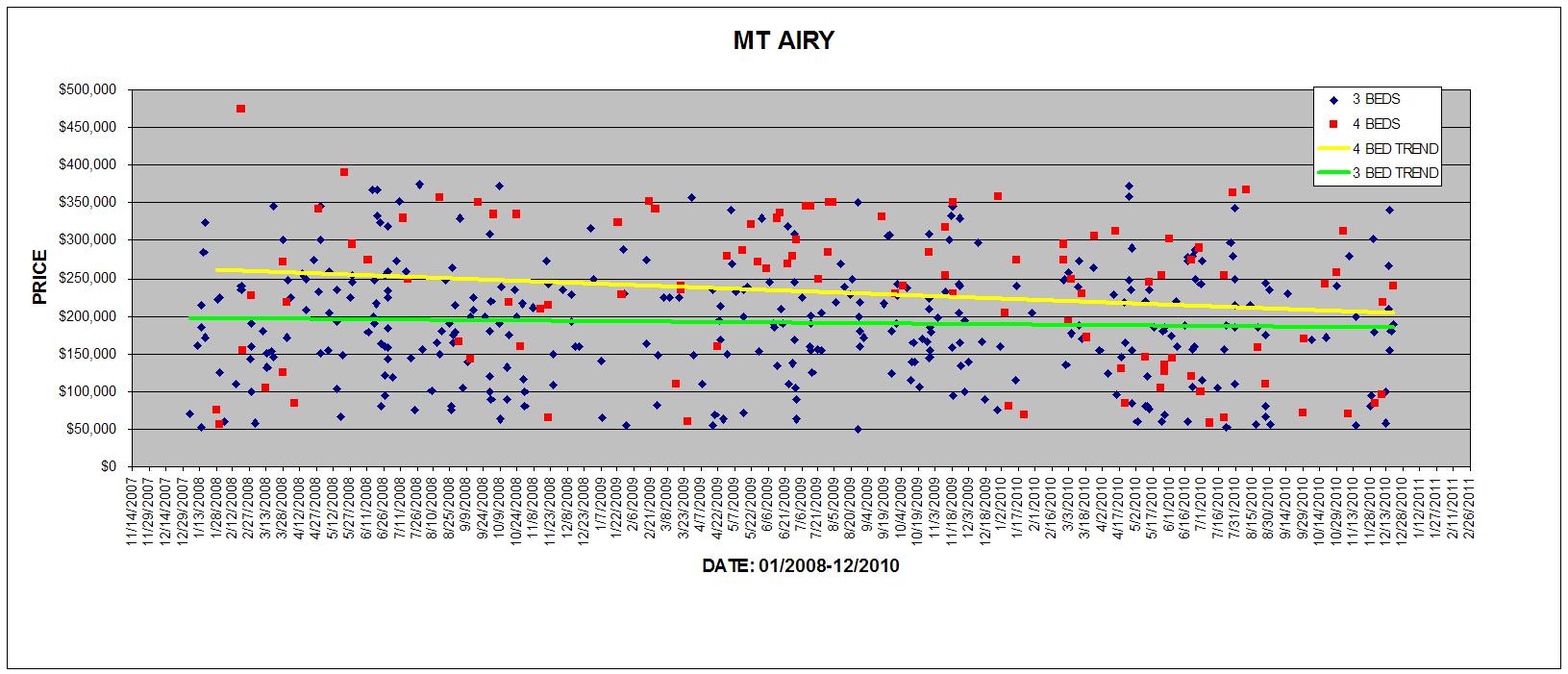
Below is a chart of the sales of 3-4 bedroom twins and rowhomes in Mt. Airy from January 2008 through December 2010.  Click on the chart to enlarge.

The blue dots indicate the sales of 3 bedroom homes; the red dots represent the 4 bedroom sales.  Our sample produced 341 sales of 3 bedrooms and 105 sales of 4 Bedroom homes, in Mt. Airy, during that time period.  The green and yellow lines depict the linear sale price trends for 3 and 4 bedroom houses, respectively.

The trend lines indicate that both 3 and 4 bedroom homes are moving downward.  However, it appears as though the 4 bedroom properties are experiencing a deeper shift that the 3 bedrooms, which are riding a flatter trend.  This is likely due to the fact that there are fewer 4 bedrooms homes and, as a result, fewer 4 bedroom sales.  With a smaller sample, it is easier for a few sales to influence the trend.  Conversely, with a greater number of samples it is less likely that a handful of sales to move the trend so dramatically.

If you have a question about real estate markets and trends in the Philadelphia region, please visit our Ask PAB! page to submit your inquiry.

Share

TReND Distressed Sales Report

TReND, the Multiple Listing Service that serves the Greater Philadelphia Markets, does a great job of publishing timely and relevant reports about real estate trends in the Philadelphia area.   Below is the report that they released this week showing the affect of Distressed Sales on the local markets.  TReND is always trying to improve their service and this is just another example of the new and innovative products that they offer.

Frankly, after reviewing the report, I was surprized to see that Philadelphia was lower in terms of distressed sales than some counties in New Jersey and Delaware.    But, it’s all relative to the total number of sales and, Philly, by far has the greatest volume of sales.

ThanksTReND!

Below is a link to the full report.  If, for some reason you can’t get to the report, let me know.

Distressed Sales: TREND Percentages Lower Than National Average. 

Share

Chestnut Hill Luxury Market

Recently, The Coyle Group, LLC Real Estate Appraisers & Consultants completed an analysis of the Chestnut Hill Luxury Home Market from January 2000 to the present.

In our analysis, the Luxury Market was defined as the top 20% of single family homes sold in Chestnut Hill. Only sales listed in the MLS were part of the analysis. Private sales and sales occurring outside of the MLS listings were not included.

There were a total of 1,186 single family homes sold in Chestnut Hill since January 2000. This figure takes into account all price points. The top 20% (totaling 237 sales) were included in this analysis as the Luxury Market. Below is a graph of the sales activity that was tracked along with a trend line that illustrates the overall trend for the Chestnut Hill Luxury Market over the span of more than 9 years.

The bottom of this segment began at $675,000 and topped out at $3,300,000. The average sale price over the entire time period was $1,060,840, with a median sale price of $912,000.

One of the metrics that were tracked was the List Price to Sale Price Ratio. The cumulative average LP/SP ratio was 96.14%. This means that, on average, since January 2000, homes in the Chestnut Hill Luxury Market have been discounted approximately 4% from their most current asking price. The time period with the most full or over full price sales was between 2004 and 2007, totaling 53. The time period with the fewest full price sales was from January 2008 to the present. In that period, there were only 9 sales that went for full price.

Observing the trend line, the Chestnut Hill Luxury Market appears to be leveling out from the highs of 2006-2008 and more recent declines through the end of 2008 thru 2010. The trend even shows signs of incremental upward movement. This is positive news for this market. However, looking at the historical data the current market is roughly in line with the market from Spring 2005.

The Coyle Group, LLC is a group of professional Real Estate Appraisers and Consultants serving the Greater Philadelphia markets, including Chestnut Hill. For more information on our services such as Pre-Listing Appraisals, please contact our office at 215-836-5500 or visit our website www.thecoylegroupllc.com .

Share

Tax Credit Expires

It happened over the weekend without much fanfare or comment.  The $8,000 homebuyer tax credit expired.  For some, it helped them make the move to homeownership.  For others, it was a much needed shot in the arm that boosted business and made everything feel like 2004-2005, again.  Many real estate agents, mortgage brokers and appraisers found themselves busy, some were even overwhelmed by the surge of business.  It felt so good that many pundits were touting the end of the housing crisis, claiming that the economic recovery is underway…look out, good times ahead!

While the economic recovery may be underway, it was not the tax credit that spurred it along.  The tax credit may prove in the weeks and months to come to have been a crutch upon which the housing market was propped. 

It will be interesting to see if the recovery has any legs now that the crutch has been removed. 

Based on what we’ve noticed in the Philadelphia markets, I think that we may see a dip in home prices in the near future.  The expiration of the tax credit may keep some first time buyers from entering the market.  This, along with new listings being added, will force pricing pressures downward as more listings chase fewer buyers.  It will be more important than ever for Philadelphia area Agents and Sellers to price their properites correctly and competitively.

The hand-out is over, interest rates are still artificially low and the tsunami of foreclosures is still on the horizon…it will be an interesting next few months.

Share